Governance patterns with tags, vocabulary, and quality signals
On this page
- What you should get from this module
- Guided walkthrough
- Role lens
- Practice assignment
- Exit criteria
- Suggested source material
Governance becomes concrete in CluedIn when signals are visible and actionable. In the currently documented material, the strongest current governance surface is Tag Monitoring, supported by vocabulary ownership and structured record groupings.
What you should get from this module
- treat tags as measurable quality signals rather than ad hoc labels
- connect governance patterns to rules, stewardship queues, and AI jobs
- use vocabulary structure to support ownership and consistency
Guided walkthrough
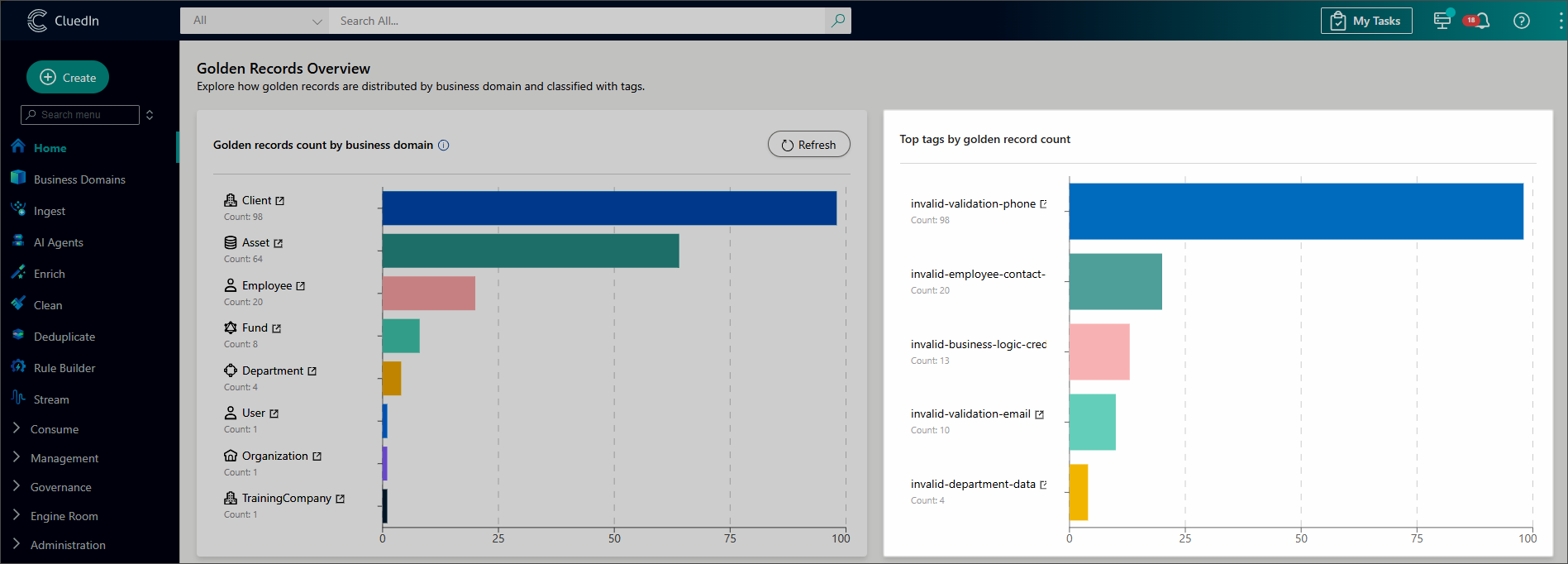
Start with Tag Monitoring. The module exposes not only tagged populations, but also trend information, rule provenance, and record lists. That means a tag can act as a governance signal with operational follow-through.
Architects should design tag usage deliberately:
- what conditions deserve a tag
- which rule type should apply it
- whether the tag is temporary triage or long-term governance signal
- what action a steward should take when the tag volume rises
Then bring vocabulary back into the discussion. Vocabulary ownership and usage views help ensure metadata structures have accountability. Governance is stronger when key vocabularies are owned, explained, and reused consistently rather than proliferating silently.
This module is also where you should teach the link between governance and remediation. A quality signal is only useful if it leads to something:
- a clean project
- an AI-assisted job
- a rule change
- a mapping review
- a source-system escalation
That is the architecture of governance: not just visibility, but decision paths.
Role lens
A governance design is good when a steward can look at a signal and know what it means, who owns it, and what the next action should be. Ambiguous governance signals are worse than missing ones because they create motion without clarity.
Practice assignment
Design one governance pattern end to end:
- the issue to monitor
- the tag name
- the rule type that should apply it
- the stewardship action when it appears
- the metric or trend you would watch
- the architectural change you would consider if the issue keeps rising
Exit criteria
- The learner can explain how tags become governance signals.
- The learner can connect signals to action paths and ownership.
- The learner understands vocabulary ownership as part of governance discipline.